The Winter's Tale
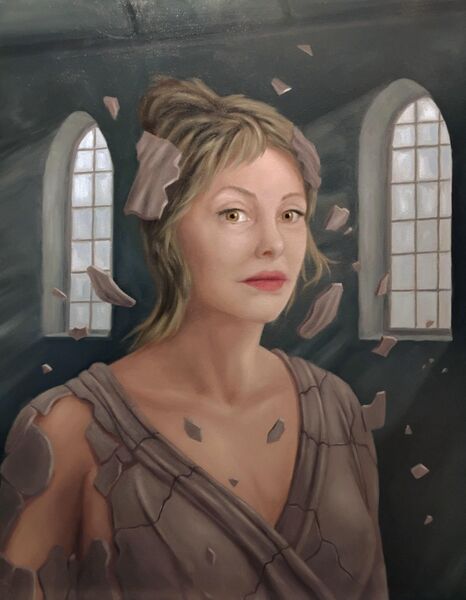
The Winter's Tale (Hermione), a painting by Iain Will Artist for the Visual Shakespeare Project

Unframed oil on board (16 x 20 inches, when unframed)

Prints will be availble soon

In Shakespeare's The Winter's Tale, Hermione's reappearance is presented as a miraculous event, but was there a more logical, human explanation?
After Hermione's public trial, where she collapses upon hearing of her son's death, her loyal friend Paulina announces that the queen has died. She then carries Hermione away, and for 16 years, everyone—including her husband, Leontes believes she is dead.
In the final scene, Paulina invites Leontes, his newly-found daughter Perdita, and others to her home to see a statue of Hermione. The statue is so lifelike that it seems to breathe, and Leontes is overcome with emotion. Paulina then claims that with music and her "art," she can make the statue come to life. The statue "moves," and it is revealed to be the real Hermione, who has been hidden by Paulina for 16 years.
While the play uses the language of magic and miracles to describe this moment, did Hermione ever actually die? Did Paulina, in her immense loyalty and wisdom, have her sequestered away, waiting for the day that Leontes had truly repented and their lost daughter was found? Was the "statue" simply Hermione herself, and her "coming to life" just the final act of a long-planned reveal?

My metaphorical reveal, depicts fragments of the supposed statue falling from Hermione, so as to show her return to Leontes. Hermione is played by the Parisian film and theatre actress, Anne Langlois. Thank you Anne.

Original painting: £650 use Contact Us

Please note, your payment receipt will appear as 'Art2enjoy'

Ref: The Winter's Tale

Location: UK and Paris

Artist: Iain Will

The Winter's Tale (Hermione), a painting by Iain Will Artist for the Visual Shakespeare Project

Unframed oil on board (16 x 20 inches, when unframed)

Prints will be availble soon

In Shakespeare's The Winter's Tale, Hermione's reappearance is presented as a miraculous event, but was there a more logical, human explanation?
After Hermione's public trial, where she collapses upon hearing of her son's death, her loyal friend Paulina announces that the queen has died. She then carries Hermione away, and for 16 years, everyone—including her husband, Leontes believes she is dead.
In the final scene, Paulina invites Leontes, his newly-found daughter Perdita, and others to her home to see a statue of Hermione. The statue is so lifelike that it seems to breathe, and Leontes is overcome with emotion. Paulina then claims that with music and her "art," she can make the statue come to life. The statue "moves," and it is revealed to be the real Hermione, who has been hidden by Paulina for 16 years.
While the play uses the language of magic and miracles to describe this moment, did Hermione ever actually die? Did Paulina, in her immense loyalty and wisdom, have her sequestered away, waiting for the day that Leontes had truly repented and their lost daughter was found? Was the "statue" simply Hermione herself, and her "coming to life" just the final act of a long-planned reveal?

My metaphorical reveal, depicts fragments of the supposed statue falling from Hermione, so as to show her return to Leontes. Hermione is played by the Parisian film and theatre actress, Anne Langlois. Thank you Anne.

Original painting: £650 use Contact Us

Please note, your payment receipt will appear as 'Art2enjoy'

Ref: The Winter's Tale

Location: UK and Paris

Artist: Iain Will